Google Search has changed substantially over the last few years, but several developments from August 2026 point toward an even bigger shift in how businesses should think about SEO.
The changes aren’t limited to rankings.
Google is simultaneously changing how it identifies spam, how AI-generated search results send users to websites, how third-party tools can collect search results, and even how certain search policies are enforced in different parts of the world.
A recent discussion in the SEO Growth community on Reddit pulled several of these developments together. The individual updates are interesting, but taken as a whole they reveal something more important:
SEO is increasingly becoming a combination of traditional search optimization, high-quality original content, technical performance, brand authority, and visibility inside AI-generated answers.
For businesses, publishers, and organizations trying to generate traffic from search, that distinction matters.
Google’s August 2026 Spam Update
Google rolled out its August 2026 spam update between August 18 and August 21. According to Google’s Search Status Dashboard, the update applied globally and across all languages.
Google did not announce a new spam policy alongside the update, which is important.
There has been considerable discussion in the SEO community suggesting that websites relying heavily on mass-produced AI content were among those affected. However, Google has not officially said that the August update specifically targeted AI-generated content.
Industry reporting instead points toward a more nuanced distinction: the problem appears less likely to be the use of AI itself and more likely to be large volumes of content created primarily to manipulate search rankings.
AI Content Isn’t Automatically Bad Content
There is a major difference between using AI to research a topic, organize information, analyze data, or help draft useful content and automatically generating hundreds or thousands of nearly interchangeable pages designed primarily to capture keywords.
AI can dramatically improve a content workflow. But automation doesn’t remove the need for editorial judgment.
A useful question when reviewing AI-assisted content is:
Would we still publish this page if Google didn’t exist?
If the answer is no, there is a good chance the page was built around a keyword rather than around something a real visitor actually needs.
The Opportunity Isn’t More AI Content. It’s Better Content With AI.
The temptation with generative AI is obvious. If producing one article previously required several hours, AI tools can dramatically reduce that production time. That makes it technically possible to publish hundreds of articles.
But just because content can be produced doesn’t mean it should be.
Businesses may actually gain a bigger competitive advantage by going in the opposite direction:
Publish fewer pages with more firsthand expertise, better research, proprietary information, stronger examples, and clearer answers.
That might include:
- original customer or project data;
- real case studies;
- screenshots and demonstrations;
- expert commentary;
- proprietary research;
- detailed comparisons;
- original photography;
- interactive tools;
- calculators;
- downloadable resources;
- FAQs based on actual customer questions; and
- links to authoritative primary sources.
AI can help assemble and improve this information.
It shouldn’t be the information.
AI Mode Is Becoming Another Search Visibility Channel
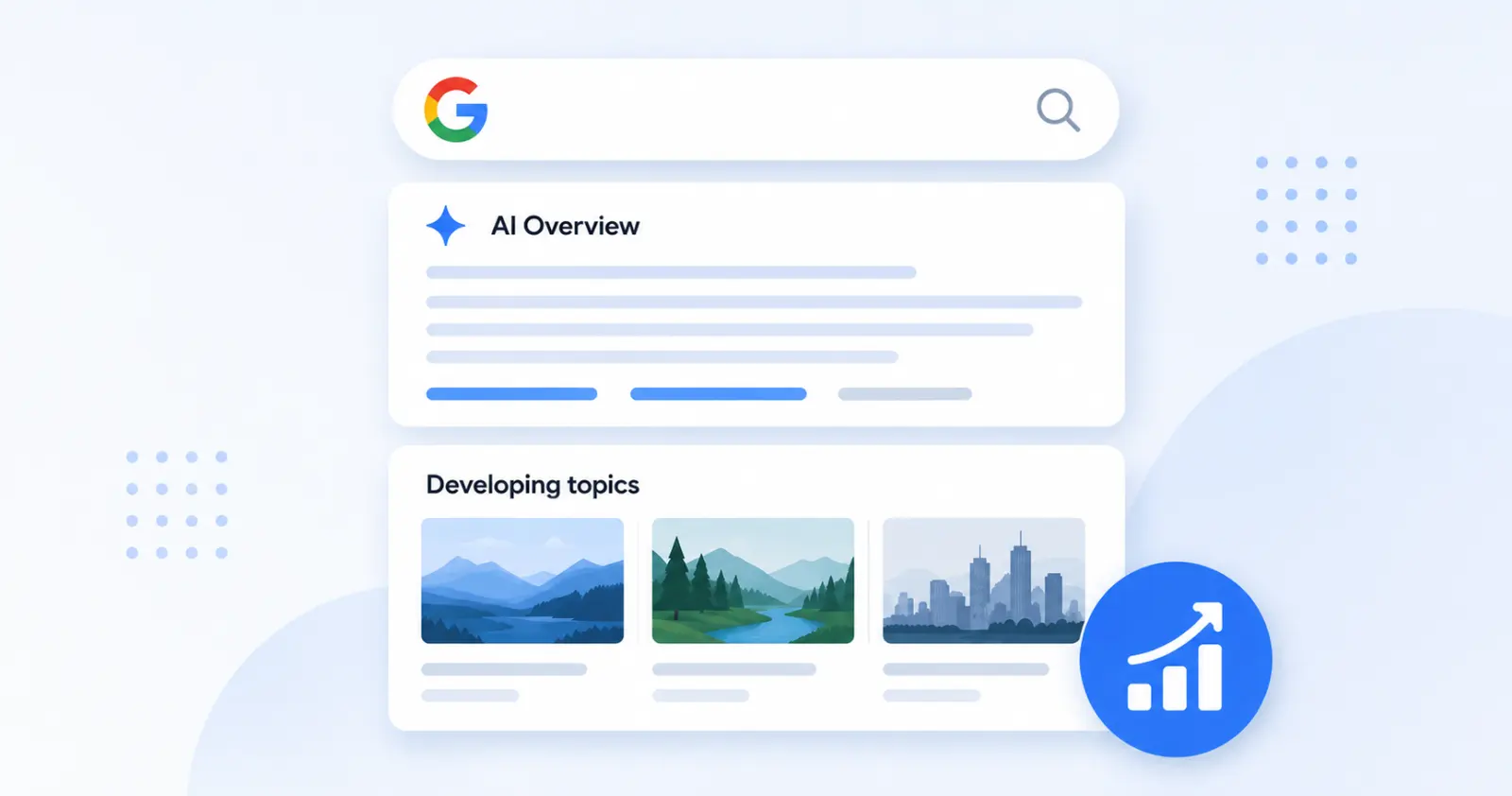
Google has begun displaying link carousels for developing topics directly inside AI Mode, expanding a format already used with AI Overviews. These carousels can display article links prominently within an AI-generated response rather than hiding sources behind small citation elements.
That may seem like a small interface change, but it points toward something much larger.
Historically, SEO revolved around ranking a webpage among Google’s traditional organic results.
Now a website might potentially appear through several different surfaces:
- traditional organic results;
- AI Overviews;
- AI Mode citations;
- AI Mode link carousels;
- Discover;
- video results;
- image results;
- local search; and
- other specialized search features.
This is one reason SEO and GEO should increasingly be treated as related disciplines rather than completely separate strategies.
SEO vs. GEO Is Becoming the Wrong Question
GEO — Generative Engine Optimization — generally focuses on making information easier for AI systems to discover, understand, trust, and cite.
Traditional SEO focuses on helping search engines crawl, understand, index, and rank webpages.
There is substantial overlap.
A well-structured page with clear headings, meaningful internal links, authoritative references, original expertise, structured data, strong technical performance, and concise factual answers is useful for both.
The objective isn’t to choose between SEO and GEO.
The objective is to build content that can become a trusted source of information wherever users are searching for answers.
Original Sources Are Becoming More Important
Google’s decision to place article carousels directly inside AI-generated responses reinforces another important strategy: become a source worth citing.
For businesses, “original coverage” doesn’t have to mean operating a newsroom.
A contractor might publish an analysis of actual project costs. A nonprofit might publish regional program statistics. A school organization might create a searchable curriculum resource. A software company might publish performance benchmarks from its own application. A tourism organization might publish local visitation data. An AI consultancy might publish retrieval benchmarks or evaluation results from systems it has actually deployed.
That type of information cannot easily be recreated by asking an AI model to write “1,500 words about a topic.”
And that’s precisely what can make it valuable.
Google Is Also Making Search Results Harder to Scrape
Google has begun rolling out google.com/goto passthrough URLs within search results rather than always exposing a publisher’s destination URL directly in the search-result markup.
For most business owners, this won’t change how they perform SEO tomorrow morning.
But it could matter for the broader SEO ecosystem.
Many rank trackers, SERP analysis products, and automated research systems depend on extracting information from search-result pages. Changes to Google’s URLs can force those platforms to change the way they collect and interpret results.
It is another reason first-party measurement is becoming increasingly important.
Businesses should be paying close attention to their own:
- Google Search Console data;
- analytics;
- conversions;
- leads;
- revenue-generating pages;
- AI-search visibility;
- branded searches; and
- server-side traffic where appropriate.
A third-party visibility score is useful.
Actual business results are more useful.
Google’s Site Reputation Policy Now Works Differently in Europe
Google also made a significant change to its site reputation abuse policy following discussions with the European Commission.
Beginning August 30, 2026, manual actions related to Google’s site reputation policy can have different effects depending on where the searcher is located.
The important lesson isn’t that businesses suddenly need two SEO strategies.
It is that search is no longer necessarily a uniform global environment.
Location, regulation, personalization, AI interfaces, and regional policies can increasingly change the results users see.
Don’t Chase Every Google Update
When rankings change after an update, the worst reaction is often to start randomly rewriting pages, deleting content, changing URLs, and adjusting technical settings without understanding what actually happened.
Instead, diagnose the change.
- Which pages lost visibility?
- Which queries changed?
- Did impressions fall, rankings fall, or both?
- Did competitors replace you?
- Did search intent change?
- Were only certain content types affected?
- Did conversions fall along with traffic?
- Did Google crawl or indexing patterns change?
An algorithm update should trigger analysis, not panic.
What Businesses Should Do Now
None of these changes mean SEO is dead.
Search visibility is simply expanding beyond the traditional list of blue links.
1. Audit low-value content
Review pages that receive little traffic, have little unique information, or substantially duplicate other pages. Improve, consolidate, redirect, or remove content when appropriate.
2. Use AI as an accelerator, not an autopilot
AI is extremely useful for research, analysis, outlining, editing, coding, classification, and content assistance. Keep humans involved where expertise, accuracy, judgment, and brand knowledge matter.
3. Publish information competitors cannot easily reproduce
First-party information is becoming increasingly valuable. Case studies, original data, proprietary tools, real-world experience, and subject-matter expertise create differentiation both search engines and AI systems can recognize.
4. Structure information clearly
Use descriptive headings, focused sections, meaningful internal links, descriptive page titles, schema where appropriate, and direct answers to important questions.
5. Build topical depth
A strong website shouldn’t contain 100 disconnected articles chasing unrelated keywords. Develop interconnected clusters of useful information around areas where the organization actually has expertise. Browse more SEO and GEO articles for related search strategy guidance.
6. Strengthen internal linking
Internal links help users discover related information while also helping search engines understand how pages and topics relate to one another.
They can also give AI retrieval systems clearer context about your site’s knowledge structure.
7. Measure AI visibility alongside organic search
Traditional rankings still matter, but they shouldn’t be the only metric.
Track whether your organization is appearing within AI Overviews, AI Mode, other AI-powered experiences, and citations when people ask questions directly related to your services or expertise.
The Bigger Shift: From Ranking Pages to Building Knowledge
Perhaps the biggest lesson from these updates is that the unit of SEO is changing.
For years the goal was largely:
Create a webpage → optimize a keyword → earn links → rank the page.
That model still matters.
But the emerging model looks more like:
Build authoritative information → structure it clearly → connect it to related knowledge → make it verifiable → allow search engines and AI systems to retrieve it → earn visibility across multiple search experiences.
Companies that simply automate the production of thousands of generic SEO articles may find that strategy increasingly fragile.
Companies that build genuinely useful collections of knowledge, tools, data, expertise, and resources have something far more defensible.
And whether the visitor finds that information through Google, an AI Overview, AI Mode, ChatGPT, another answer engine, or a traditional link becomes increasingly secondary.
The real goal is becoming a source worth finding — and worth citing.
References & Further Reading
- Google Search Central — Update to the Site Reputation Policy
- Google Search Central — Google Search Spam Updates
- Google Search Central — Search Status Dashboard
- Google Search Central — Generative AI Performance Reports
- Search Engine Journal — August 2026 Spam Update
- Search Engine Journal — AI Content and the Spam Update
- Search Engine Journal — AI Mode Link Carousels
- Reddit / r/seogrowth — Original discussion that inspired this article