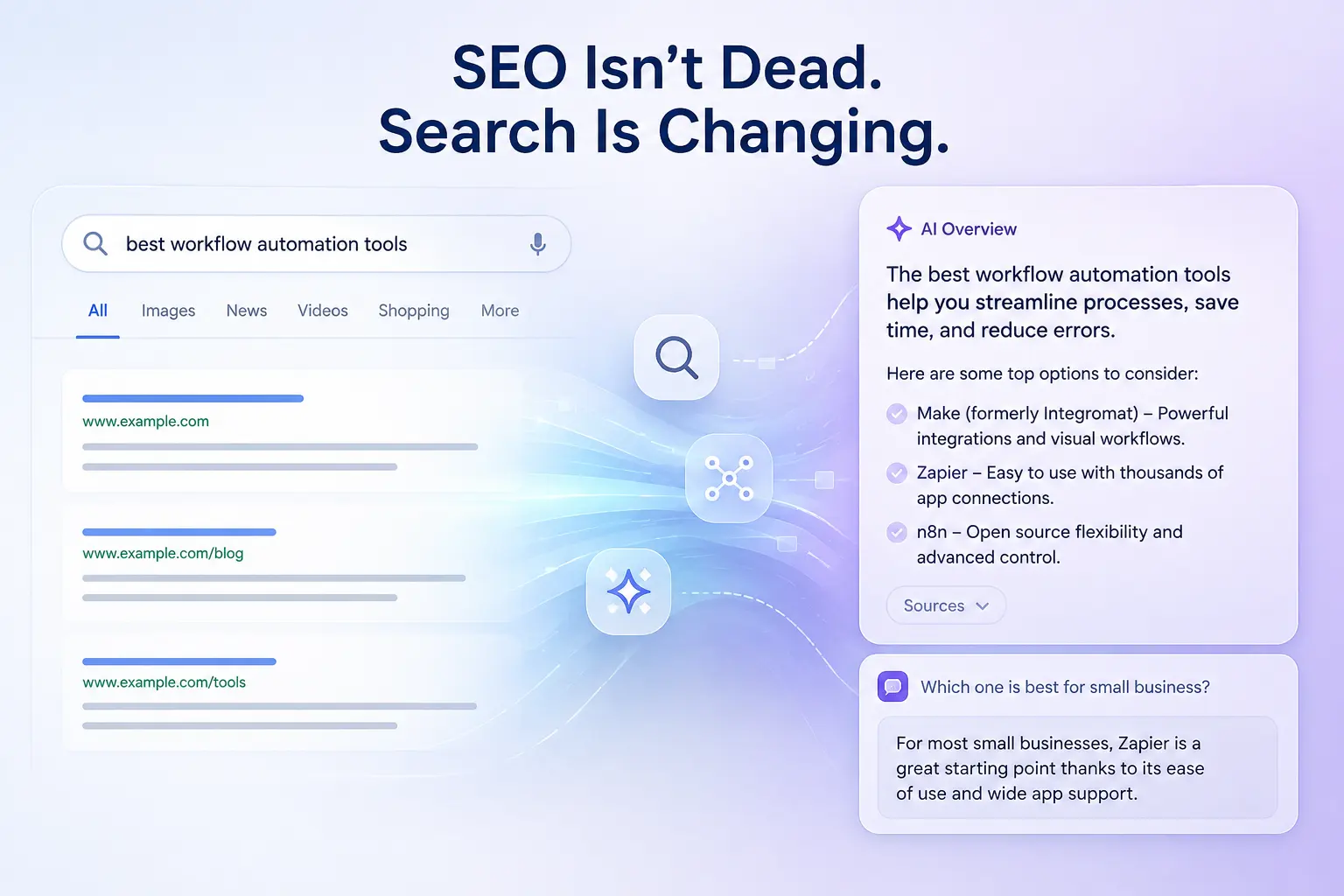
But the way people search is changing. Customers are increasingly getting answers directly from Google’s AI-powered search features, ChatGPT, and other tools that can research, compare, and recommend businesses without requiring someone to click through ten traditional search results first.
That has led to a new term showing up in digital marketing conversations: GEO, or Generative Engine Optimization.
So does that mean SEO is dead?
Not even close.
In fact, many of the things that make a website perform well in traditional search are the same things that help search engines and AI systems understand the business behind the website.
SEO Still Provides the Foundation
Traditional search engine optimization is about making it easier for search engines to understand what your website is about, who you serve, where you operate, and why your content may be useful to someone searching for what you offer.
That includes things like:
- Clear page titles and headings
- Useful service pages
- Location-specific information
- Fast, mobile-friendly pages
- Logical site navigation
- Good internal linking
- Original, useful content
- Accurate business information
- Reviews and other trust signals
Those fundamentals haven't disappeared because AI has entered search.
Google's own guidance says that existing SEO best practices remain relevant for its AI-powered search experiences, including AI Overviews and AI Mode. There isn't a secret second version of your website that needs to be built just for AI.
So What Is GEO?
GEO is generally used to describe efforts to make a business or website easier for generative AI systems to understand, reference, and potentially recommend.
I think the simplest way to look at it is this:
SEO helps your website get found. GEO helps make your business understandable enough to become part of the answer.
There is a lot of overlap between the two.
If your website clearly explains what your company does, where you do it, who you work with, what problems you solve, and why someone should trust you, that information is useful to both traditional search engines and AI-powered search systems.
Search Is Becoming More Conversational
People don't always search with short keyword phrases anymore.
Instead of typing:
bozeman web designer
someone might ask:
Who can build a custom website for a service business in Bozeman that also needs forms and workflow automation?
That's a very different kind of search.
It gives the search system more context, and it gives businesses an opportunity to be discovered for the specific problems they solve rather than simply a handful of keywords.
That's one reason detailed, well-written website content is becoming more important, not less.
Your Website Needs to Explain Your Business Clearly
One of the biggest problems I see with business websites is that they assume visitors already understand the company.
The homepage might say things like:
- Quality you can trust
- Solutions for your business
- Serving Montana since 1998
Those statements aren't necessarily bad, but they don't tell a search engine, an AI system, or even a new visitor very much.
A stronger site answers specific questions:
- What exactly do you do?
- What services do you provide?
- Who are those services for?
- What geographic area do you serve?
- What makes your approach different?
- What kinds of problems do customers hire you to solve?
That kind of clarity helps humans and machines at the same time.
Individual Service Pages Matter
A single Services page with five one-sentence descriptions is better than nothing, but it usually isn't enough to explain a business in depth.
If SEO is important to you, your major services should generally have their own useful pages.
For example, a contractor might have separate pages for:
- Custom home construction
- Home remodeling
- Timber framing
- Commercial construction
Those pages give you room to answer the real questions customers have about each service.
They also create much clearer signals about what the company actually does.
Local Information Is Still Extremely Important
For local businesses, geography matters.
Your website should make it clear where you are based and what areas you actually serve.
That doesn't mean stuffing "Bozeman, Montana" into every paragraph.
It means naturally providing useful local context throughout the site: your service area, projects you've completed nearby, communities you work in, locally relevant questions, testimonials, and other real-world information about the business.
A complete Google Business Profile and consistent information across the web remain important parts of local visibility as well.
AI Search Still Needs Information to Work With
AI systems aren't magic directories of every business in town.
They need accessible information from the web and other sources to understand businesses and answer questions about them.
That means having a website that can actually be crawled is still important.
For example, OpenAI provides a crawler called OAI-SearchBot that can access public website content for ChatGPT search when a site allows it.
This is another reason technical SEO and GEO shouldn't be treated as completely separate disciplines. Crawlability, good site structure, useful content, and clear information all overlap.
Don't Write for Robots
There's an understandable temptation to start creating enormous amounts of content specifically to "feed AI."
I don't think that's the right approach.
Google continues to emphasize useful, original, people-first content. AI-generated content isn't automatically a problem, but publishing pages simply because you hope to manipulate search results is unlikely to build a strong website over the long term.
The better strategy is to answer the questions real customers ask.
If clients repeatedly ask you the same question during phone calls, estimates, or sales meetings, there's a good chance that question deserves a page or article on your website.
What Should a Local Business Do Right Now?
You don't need to rebuild your entire marketing strategy because AI search exists.
Start with the basics:
- Make sure your website clearly explains your services.
- Create useful pages for your most important services.
- Clearly identify your location and service area.
- Keep your Google Business Profile accurate and active.
- Publish genuinely useful information about the questions your customers ask.
- Make sure search engines and appropriate AI search crawlers can access the site.
- Build a website people actually want to use.
The Goal Hasn't Really Changed
Search technology will continue to evolve.
Ten blue links became maps, featured snippets, local packs, shopping results, AI Overviews, and conversational search.
But the underlying goal is remarkably consistent:
Make it easy for the right person to discover your business and understand why you may be able to help them.
Good SEO does that.
Good GEO should do the same thing.
And increasingly, I don't think businesses should treat them as two completely separate strategies.
References & Further Reading
The recommendations in this article are based in part on current guidance from Google and OpenAI. Search features and crawler behavior can change, so these resources are worth reviewing periodically.
- Google Search Central: AI Features and Your Website — Google's guidance on AI Overviews, AI Mode, technical eligibility, and why existing SEO best practices continue to apply.
- Google Search Central: Optimizing Your Website for Generative AI Features — Google's current recommendations for visibility in generative AI search, including content quality, technical SEO, and site structure.
- Google Search Central: Creating Helpful, Reliable, People-First Content — Google's guidance on creating content for people rather than primarily for manipulating search rankings.
- OpenAI: ChatGPT Search — OpenAI's guidance on making website content available to ChatGPT search, including OAI-SearchBot.
- OpenAI: Publishers and Developers FAQ — Additional information about OAI-SearchBot and tracking referral traffic from ChatGPT.
References reviewed August 2026.